Best Coding Bootcamps vs Computer Science Degree: Which Pays Off Faster
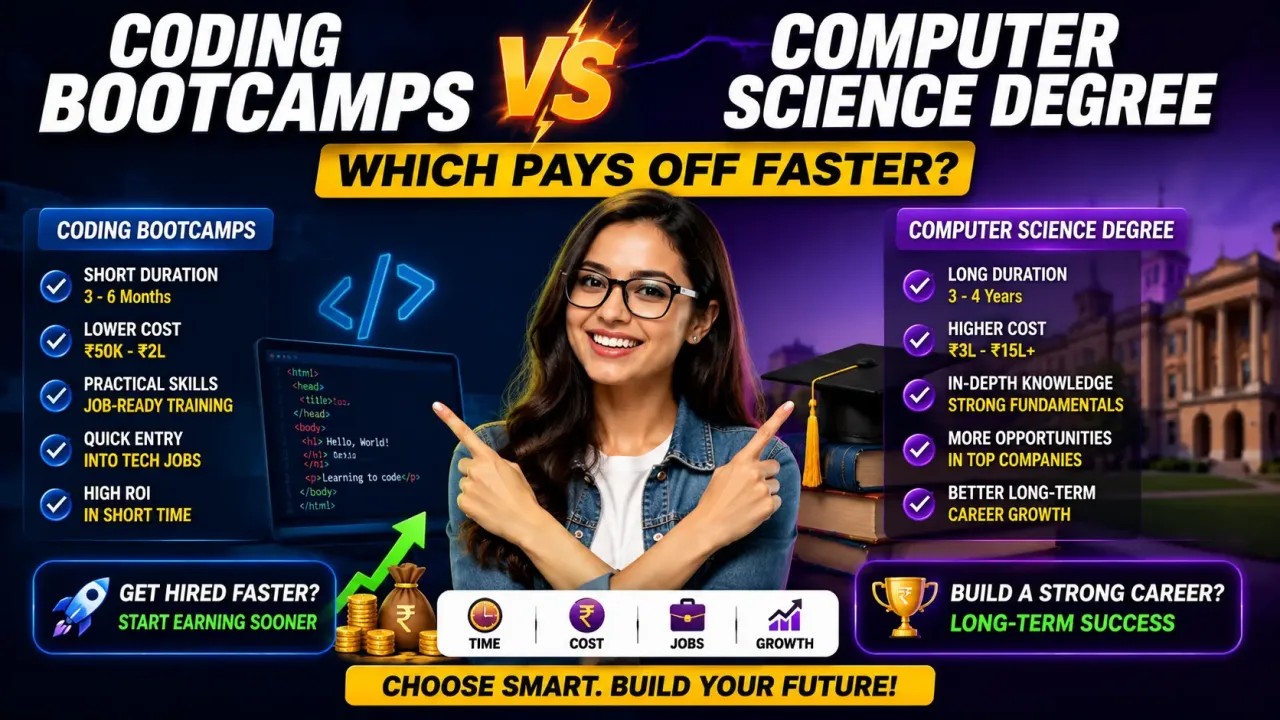
Picture two people standing at the same fork in the road. One signs up for a 14-week coding bootcamp and starts writing code by next Monday. The other packs a bag, moves into a dorm, and signs up for four years of lectures, labs, and late-night study sessions. Fast forward a few years, and both of them are working as software developers, sitting a few desks apart, writing the same kind of code.
So... which one made the smarter call?
If you've been eyeing a career switch into tech — or you're a parent trying to figure out where to point your kid's tuition money — this is probably the question keeping you up at night. And honestly, there isn't a one-size-fits-all answer. But there is a real, numbers-based answer, and that's exactly what we're going to dig into.
What this article covers
The Big Difference: Time and Money Up Front#
Let's start with the obvious stuff, because it matters more than people admit.
A coding bootcamp usually runs somewhere between 12 and 24 weeks. Tuition typically lands in the $11,000 to $15,000 range on average, though some programs charge as little as a few hundred dollars and premium in-person intensives can run past $20,000. Add in a laptop, a few months of no paycheck, and maybe rent in a city with tech jobs, and your real cost might creep closer to $20,000-$25,000 — but you're done in a season, not years.
A computer science degree, on the other hand, is a multi-year commitment. In-state public tuition alone can land anywhere from roughly $40,000 to $120,000 for four years, and that's before you factor in dorms, meal plans, books, and the wage income you're not earning while you're a full-time student. Go to an out-of-state public school or a private university, and that number climbs fast — sometimes well past $150,000, even after financial aid chips away at the sticker price.
Here's the thing though: cost isn't the whole story. It's cost relative to what you get back.
Show Me the Money: Starting Salaries#
This is where it gets interesting.
Bootcamp graduates report an average first salary somewhere around $70,000, with roughly 79% landing a job in tech within six months of finishing. That's a real, livable outcome for someone who spent a few months and a fraction of a degree's cost getting there.
Computer science graduates, meanwhile, are pulling in noticeably more right out of the gate. According to recent salary survey data, computer science majors are commanding starting salaries north of $80,000 on average — and that's just the average. Land a spot at a well-known tech company and total compensation packages for entry-level software engineering roles can stretch into the $140,000-$190,000 range once you count signing bonuses and stock.
So on pure starting salary, the degree wins. No contest.
But "wins on salary" and "pays off faster" are two very different questions.
The Real Question: Break-Even Time#
This is the part most comparisons skip, and it's honestly the whole point.
Because a bootcamp costs so little and takes so little time, graduates tend to recoup their investment shockingly fast — often within about five months of landing their first paycheck. Think about that. Five months. You could be underwater on tuition in January and fully in the black by June.
A CS degree takes a lot longer to pay for itself, simply because there's so much more to pay back. Even with a strong starting salary, when you add up four (or more) years of tuition, room, board, and lost wages, most estimates put the break-even point somewhere between two and twelve years, depending heavily on which school you attended and what you're paying in tuition versus financial aid. Someone who went to a low-cost in-state public school with decent aid might break even in under two years. Someone who took out six figures in loans for a private university could be paying that off for the better part of a decade.
So if "pays off faster" means "gets you back to zero the quickest," bootcamps usually win by a wide margin — assuming you actually land the job.
And that "assuming" is doing a lot of heavy lifting.
The Catch Nobody Puts on the Brochure#
Here's what the marketing glosses over on both sides.
Bootcamps are a bet on speed and hustle. You're compressing years of foundational computer science knowledge — data structures, algorithms, how operating systems actually work — into a few intense months. That works beautifully for people who are self-motivated, already comfortable with logical thinking, and willing to grind outside of class hours. It works less well if you're hoping the bootcamp alone will hand you a job. Roughly one in five bootcamp grads doesn't land a tech role within six months, and the entry-level market has gotten more competitive in the last couple of years, not less.
A CS degree, meanwhile, is a bet on depth and credibility. You come out the other side with a broader technical foundation, a diploma that some hiring managers still lean on as a filter, and access to internships and campus recruiting pipelines that bootcamps generally can't offer. The tradeoff is time, cost, and the very real risk of graduating with a mountain of student debt that follows you for years, regardless of whether the job market cooperates when you finish.
Neither path guarantees a job. Both paths have plenty of success stories and plenty of people who wish they'd chosen differently.
So Which One Should You Actually Pick?#
Here's a simple way to think about it.
A bootcamp probably makes sense if:
- You already have a degree (in anything) and are switching careers
- You learn well under pressure and don't mind an intense, short-term grind
- You want to start earning again as quickly as possible
- You're comfortable being self-directed once the structured part ends
A computer science degree probably makes sense if:
- You're straight out of high school with time on your side
- You're aiming for roles that specifically require or strongly prefer a degree — think large tech companies, research positions, or graduate school later on
- You can attend an in-state or well-funded school without taking on crushing debt
- You want the deeper theoretical foundation, not just job-ready skills
There's also a quiet third option worth mentioning: plenty of self-taught developers skip both paths entirely, building a portfolio through free resources and open-source contributions, then apply directly. It's slower and requires serious self-discipline, but it costs close to nothing.
The Bottom Line#
If you're measuring "pays off faster" strictly in dollars and months, coding bootcamps usually win the race — lower cost, shorter timeline, quicker break-even. If you're measuring long-term earning ceiling, career flexibility, and access to the most competitive employers, a computer science degree still holds real advantages, even if it takes years longer to pay for itself.
The truth is, this isn't really a competition between two paths so much as a decision about what kind of risk you're comfortable taking. A bootcamp asks you to bet on speed. A degree asks you to bet on depth. Both bets can pay off — the trick is picking the one that matches your actual situation, not the one that sounds better at a dinner party.
Whichever way you lean, do the math on your specific numbers before you commit. Tuition costs, financial aid, your local job market, and your own learning style will matter more to your outcome than any national average ever could.

Read next

AI Laptops Revolutionize Video Editing in Just a Few Clicks
Remember the days when editing a five-minute YouTube video meant sitting hunched over your laptop till 2 AM, manually trimming clips, adjusting audio levels frame…

Best AI Smartphones Top Vloggers Are Using in 2026
Watch any successful vlog these days and you'll notice something: barely any of it was shot on a "proper" camera. The buttery-smooth walk-and-talk footage, the…

High Performance AI Laptops Under Rs 40,000 for Graphic Designing in 2026
If you've ever sat down to open Photoshop on a cheap laptop and watched the loading circle spin for what felt like an eternity, you already know the…

AI Laptops vs Gaming Laptops for Video Editing: Which Is Better?
You're staring at two browser tabs, both open for way too long. One is a sleek "AI laptop" with a marketing page full of words like "neural engine"…
0 comments