Best Online Degree Programs in 2026: Cost, ROI & How to Apply

There's a specific kind of moment a lot of people hit in their late twenties or thirties: you're sitting at your desk, coffee going cold, wondering if you should've finished that degree — or gotten a different one entirely. Maybe you're stuck at a promotion ceiling because you're missing a credential. Maybe you're just tired of watching your job get harder while your paycheck stays exactly the same. Whatever the reason, "should I go back to school online?" is one of those questions that used to come with a lot of baggage. Online degrees had a reputation problem for years — dismissed as the easy way out, or worse, not taken seriously by employers at all.
That reputation is basically gone now. It's 2026, and online education isn't the backup plan anymore — for millions of students, it's simply the plan. So let's talk honestly about what a good online degree actually costs, whether it pays off, and how to go about applying without wasting your time on a program that isn't worth your money.
What this article covers
Online Degrees Aren't a Niche Anymore — They're the Norm#
Here's a number worth sitting with: more than 3.7 million undergraduates were enrolled exclusively online at four-year institutions in the most recent academic year on record, and well over 8 million students take at least one online course. Nearly every university in the country now offers some form of online learning, compared to a small fraction less than a decade ago.
More importantly, the stigma has faded because the results have caught up. A recent employer survey found that the overwhelming majority of companies — north of 87% — have hired graduates with online degrees, and a solid majority of HR leaders now rate online learning as equal to, or even better than, traditional in-person instruction. The filter employers actually care about isn't whether your classes happened on a screen. It's whether your school is properly accredited.
Accreditation: The One Thing You Genuinely Cannot Skip#
If you take away exactly one thing from this article, make it this: never enroll in a program without regional accreditation (or, for business programs specifically, AACSB, ACBSP, or IACBE accreditation). This isn't a technicality. Accreditation determines whether your credits transfer if you switch schools, whether you qualify for federal financial aid, and whether licensing boards in fields like nursing or education will even recognize your degree.
A cheap, flashy program from an unaccredited school might look like a bargain on the surface, but it can quietly become worthless the moment you try to use it for a job application or a graduate school application. Always check accreditation status directly through the U.S. Department of Education's database before you hand over a single dollar.
What Online Degrees Actually Cost in 2026#
Now for the part everyone actually wants to know: the money.
On average, online degree programs run around $12,000 a year, compared to roughly $19,000 a year for their on-campus equivalents — a gap of about 36%. That difference adds up fast once you factor in what online students typically avoid altogether: dorm fees, meal plans, campus parking passes, and in a lot of cases, the need to quit a job to attend full-time.
That said, "online" doesn't automatically mean "cheap." The range is enormous. On one end, you've got public university programs charging just over $100 per credit hour — University of Florida's online bachelor's program, currently ranked #1 nationally, charges in-state students around $129 per credit. On the other end, premium private online master's programs (especially online MBAs) can run well past $100,000 total. The lesson here isn't "cheaper is always better" or "expensive means better quality" — it's that price and prestige don't move in a straight line, so it pays to actually compare programs rather than assuming the priciest option is automatically the smartest choice.
The ROI Question: Does It Actually Pay Off?#
This is where things get genuinely interesting, because the return on an online degree depends heavily on what you study — arguably more than where you study it.
Fields like computer science, data science, cybersecurity, business administration, and healthcare management currently offer some of the strongest returns, mostly because they lead into high-demand, well-paying careers relatively quickly after graduation. A great example that keeps coming up in ROI comparisons: Georgia Tech's online Master of Science in Computer Science costs a fraction of an in-person equivalent — often cited around $7,000 total, versus $70,000 or more for a comparable in-person program at a similarly ranked school — while graduates report strong starting salaries and, since most students keep working full-time throughout, they avoid the income loss that usually comes with going back to school. That combination of low cost and no lost income is exactly why it's regularly flagged as one of the best-value graduate programs available anywhere, online or off.
The pattern holds more broadly: an online degree tends to pay off fastest when it (a) comes from an accredited, respected institution, (b) targets a field with real hiring demand, and (c) lets you keep earning a paycheck while you study. Miss any one of those three factors, and the math gets a lot shakier.
One caveat worth being upfront about: online programs, on average, see somewhat lower completion rates than on-campus ones. If a program doesn't offer real academic support, advising, or a clear structure to keep you on track, your odds of finishing — and actually capturing that ROI — go down. Completion support isn't a "nice to have." It's part of what you're paying for.
How to Actually Apply: A Simple, Realistic Roadmap#
Once you've picked a direction, the application process for most accredited online programs looks a lot more familiar than people expect. Here's the general flow:
1. Shortlist programs by accreditation and outcomes, not marketing. Skip the schools with the flashiest ads and go straight to accreditation databases and independent rankings (U.S. News, for instance, publishes yearly online program rankings by discipline). Cross-check tuition, graduation rates, and — if available — post-graduation salary or employment data.
2. Check the actual admission requirements. Undergraduate programs typically want a high school transcript or GED, sometimes standardized test scores (though many schools have dropped this requirement), and a completed application. Graduate programs usually require a bachelor's degree from an accredited school, transcripts, a resume, letters of recommendation, and often a personal statement explaining your goals.
3. Gather your documents early. Transcripts can take weeks to arrive, especially from schools you attended years ago. Recommendation letters need lead time too — ask at least a month before any deadline, and give your recommender context about the program and why you're applying.
4. Write a statement that's actually specific. If a personal statement or essay is required, resist the urge to write something generic about "wanting to grow professionally." Explain the specific gap you're trying to close — a skill you need, a role you're aiming for, a plan you already have in motion — and how this particular program gets you there.
5. Apply for financial aid and check employer tuition assistance. Fill out the FAFSA if you're a U.S. student, even if you assume you won't qualify for much — many programs use it to determine eligibility for scholarships too. It's also worth checking directly with your employer's HR department; tuition reimbursement or assistance programs are more common than people realize, and plenty of working professionals fund a large chunk of their online degree this way without ever mentioning it publicly.
6. Confirm the schedule actually fits your life. Before you commit, get specific about how the program is structured — live classes at set times, fully self-paced modules, or a hybrid of both. A program that looks perfect on paper can become miserable fast if the schedule doesn't actually match your work hours or time zone.
A Quick Real-World Comparison#
Imagine two people, both aiming for a career shift into tech. One enrolls in a self-paced online computer science master's from a respected public university, keeps working full-time, and pays around $10,000 total over two years. The other quits their job to attend an in-person program at a similarly ranked school, paying $70,000 in tuition plus roughly two years of lost income. Both walk away with comparable job prospects and starting salaries. One of them is also tens of thousands of dollars ahead and never had a gap in their resume.
That's not a knock on in-person education — for some fields and some people, it's still the better fit. But it's a clear illustration of why "online" and "lesser" stopped being synonyms a while ago, and why so many working adults are choosing this route deliberately, not as a last resort.
The Bottom Line#
The best online degree programs in 2026 aren't defined by flashy branding or how many ads you've seen for them — they're defined by accreditation, real outcomes data, and whether the field you're studying actually leads somewhere. Costs vary enormously, from a few thousand dollars for a lean, self-paced master's to well over six figures for a premium brand-name program, and the right choice depends entirely on your budget, your career goals, and how much you value prestige versus pure value.
Do the homework before you apply: check accreditation, compare real costs against real outcomes, and pick a program that fits into your life rather than forcing your life to fit around it. Do that, and an online degree in 2026 isn't just a legitimate path — for a lot of people, it's genuinely the smarter one.

Read next

Difference Between MBA and PGDM: Degree vs. Diploma Insights
If you've spent even ten minutes scrolling through college forums or talking to seniors about management studies, you've probably run into this exact confusion…
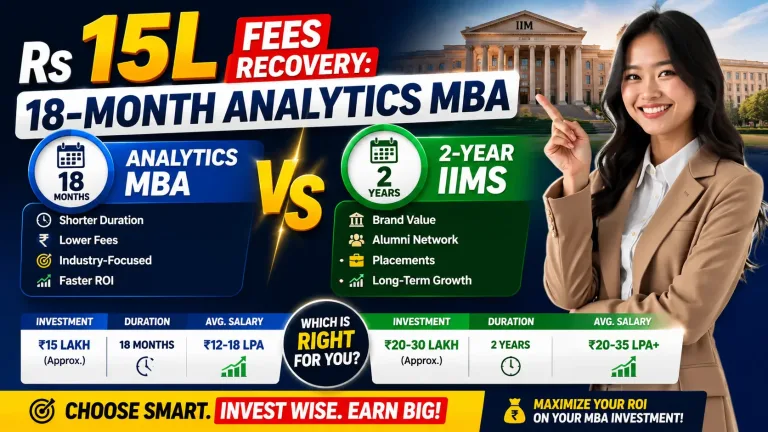
Rs 15L Fees Recovery: 18-Month Analytics MBA vs 2-Year IIMs
Picture this: you've just gotten two admit letters on the same day. One is from a well-known 2-year MBA program at an IIM, fees somewhere north of ₹20…

MBA in HR Jobs & Salary 2026: Key Insights for Success
Ask ten people what an HR department actually does, and at least half of them will say something like "they handle the paperwork" or "that's where you go…

Top 5 In-Demand MBA Specializations in 2026 for High-Paying Jobs
You know that moment when you're filling out an MBA application and you hit the dropdown menu for "specialization," and suddenly your cursor just... hovers there?…
0 comments