MBA in HR Jobs & Salary 2026: Key Insights for Success
Ask ten people what an HR department actually does, and at least half of them will say something like "they handle the paperwork" or "that's where you go when there's a complaint." If you're considering an MBA in HR, you've probably already figured out that this reputation is wildly outdated — but it's worth saying out loud anyway, because it explains why so many talented people overlook one of the most strategically important, well-compensated paths in business school today.
HR in 2026 isn't the department that just processes onboarding forms and organizes the holiday party. It's the function deciding how companies attract talent in a brutally competitive hiring market, how they retain people when a competitor dangles a bigger salary, and increasingly, how they deploy AI tools without alienating the very employees those tools are meant to support. An MBA in HR puts you right in the middle of that shift — and it pays a lot better than most people assume. Let's break down exactly what that career path looks like, what it pays, and how to actually succeed in it.
What this article covers
Why HR Has Quietly Become a Strategic Career Path#
The shift didn't happen overnight, but it's undeniable now. Industry reports show a large majority of HR functions are actively investing in AI tools, and a significant share of routine HR administrative work can now be automated. That might sound like bad news for the field — fewer manual tasks, right? — but it's actually the opposite. As the repetitive parts of HR get automated away, what's left is the strategic, people-facing, high-judgment work: workforce planning, employee experience design, compensation strategy, and organizational development. Those are exactly the skills an MBA in HR is built to sharpen.
The broader numbers back this up too. HR and administration hiring is projected to grow steadily over the next few years, and the global HR technology market is expected to keep expanding well past its current size by the end of the decade. In plain terms: the department is growing, the tools are changing, and the people who understand both the human side and the strategic side of the business are the ones who'll be running it.
What Does an MBA in HR Actually Cover?#
An MBA in Human Resource Management blends traditional HR fundamentals — talent acquisition, training and development, performance management, compensation and benefits, and labor relations — with the broader strategic and financial training you'd expect from any MBA. What's changed recently is the emerging layer on top of all that: HR analytics, AI-assisted workforce planning, employee experience design, and diversity and inclusion strategy are now core parts of most updated HR curriculums, not electives tacked on at the end.
That combination matters more than it might seem. A traditional HR generalist can manage day-to-day employee relations, but a strategic HR leader who also understands data, finance, and workforce planning is the one who ends up in the room when leadership is deciding how to restructure a department or roll out a new performance system company-wide.
The Job Roles You Can Actually Step Into#
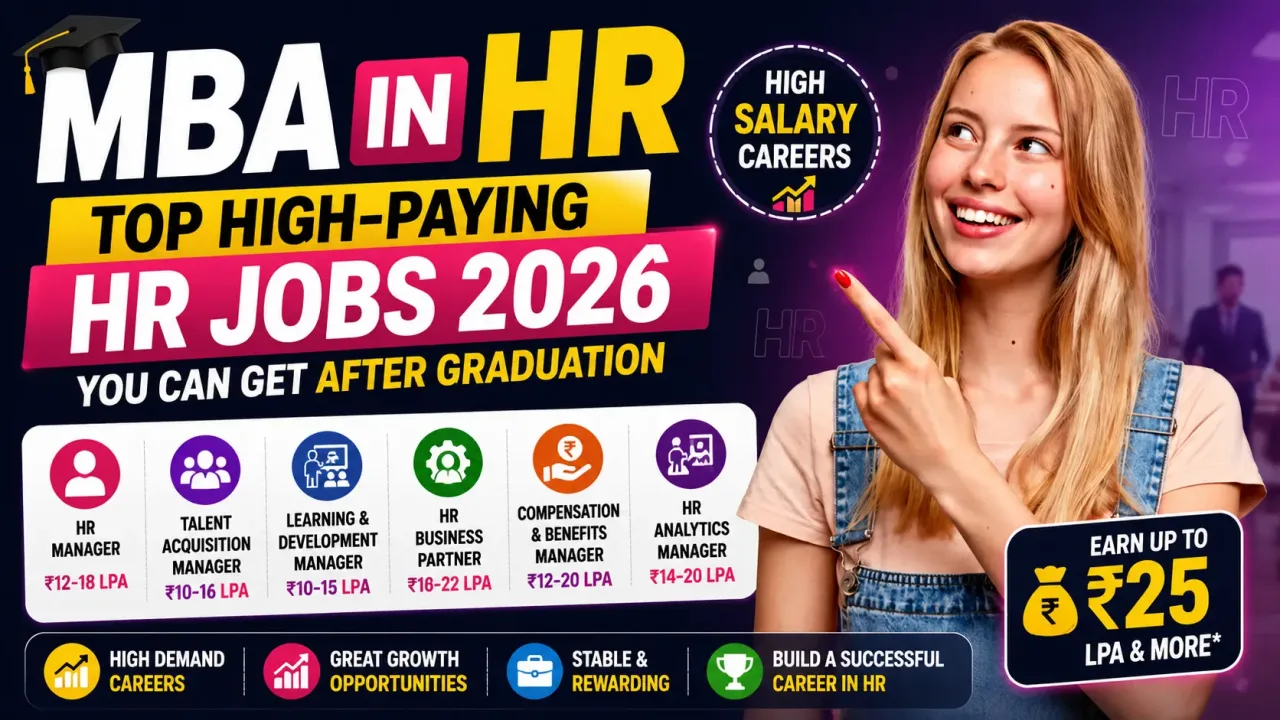
Here's where it gets concrete. Graduates with an MBA in HR typically move into roles like:
- HR Manager – overseeing the employee lifecycle, from hiring through offboarding, for a department or division
- HR Business Partner (HRBP) – working directly with business unit leaders to align people strategy with company goals
- Talent Acquisition Manager – building and running the hiring strategy, often for high-growth or high-demand roles
- Learning & Development Manager – designing training programs and career growth pathways for employees
- HR Analyst – using workforce data to guide decisions on retention, compensation, and organizational structure
- HR Director / VP of HR – setting overall people strategy and sitting close to executive-level decision-making
Notice the range here. Some of these roles are hands-on and people-focused; others lean heavily into data and strategy. That range is actually one of the biggest advantages of this career path — you're not locked into one lane, and you can shift your focus as your interests (or the market) evolve.
Let's Talk Salary: What the Numbers Actually Say#
This is usually the part people skim straight to, so let's be direct about it — and honest about the fact that the numbers vary a lot depending on where you're working and how senior you are.
In the United States, HR Manager salaries have a wide range depending on experience and company size. Entry-level HR managers (roughly three to five years of relevant experience) typically start somewhere between $75,000 and $95,000. Mid-level managers with five to eight years of experience often land closer to $96,000-$105,000, and once you move into a director-level role with eight or more years of experience, national midpoints climb to around $145,000. At the very top end — large organizations, high-cost-of-living regions, or specialized compensation and labor relations roles — total pay can comfortably exceed $190,000, and senior HR executives at major corporations sometimes clear $200,000 to $300,000 or more when bonuses and equity are factored in.
For students pursuing their MBA in HR at a top-ranked business school specifically, the picture is even stronger straight out of the gate: median base salaries for graduates of leading HR-focused MBA programs have been reported in the $82,500 to $109,000 range, with graduates going on to work at companies like Amazon, Accenture, KPMG, PwC, and Deloitte.
In markets like India, the trajectory looks similarly promising, just at different absolute numbers. HR Managers in talent acquisition or training functions typically see average packages in the range of ₹13-14 lakhs per year, with senior HR Director-level roles climbing toward ₹20-50 lakhs annually at large, well-resourced companies. Top recruiters pulling from MBA HR programs in that market include Reliance Industries, Amazon, KPMG, Infosys, Deutsche Bank, and L'Oréal, among others.
The pattern across both markets is consistent: your salary ceiling in HR is a lot higher than people assume, but reaching it depends heavily on moving from generalist to strategic roles — which is exactly what a well-chosen MBA is designed to help you do.
What Actually Separates a Good HR Career From a Great One#
Here's something worth sitting with: two people can graduate with the same MBA in HR and end up in very different places five years later. The difference usually isn't luck — it's a handful of specific choices.
Learn the data side, even if it's not your favorite part. HR analytics has gone from "nice to have" to genuinely expected at the manager level and above. You don't need to become a data scientist, but being comfortable pulling insights from turnover data, engagement surveys, or compensation benchmarking will set you apart from HR professionals who are still purely relationship-driven.
Specialize, but stay flexible. Whether it's talent acquisition, compensation strategy, or organizational development, having a clear specialty makes you more hireable for senior roles. But don't specialize so narrowly that you can't pivot if that particular niche cools off — the HR functions in highest demand shift over time as the broader labor market shifts.
Get comfortable being the "AI translator" in the room. As companies roll out AI tools for recruiting, performance reviews, and workforce planning, someone needs to make sure those tools are actually fair, effective, and don't quietly damage employee trust. HR professionals who can bridge that gap between technology teams and the human side of the business are becoming disproportionately valuable, and this is only going to intensify over the next few years.
Think beyond your first job title. A lot of people treat "HR Manager" as the destination rather than a waypoint. The professionals earning the highest salaries in this field are almost always the ones who moved into HR Business Partner or Director-level roles, where they're influencing company strategy directly rather than just executing HR processes handed down from above.
A Realistic Example#
Consider someone who spends three years as a generalist HR coordinator, then completes an MBA in HR with a concentration in analytics. Instead of returning to a similar generalist role, they move into an HR Business Partner position at a mid-sized tech company, where they spend two years building retention strategies backed by actual turnover data. From there, promotion into a Director of People Operations role — with a salary well above what a traditional HR generalist path would have offered in the same timeframe — becomes a realistic, well-supported next step. The MBA didn't just add a credential to their resume; it gave them the strategic and analytical vocabulary to make that jump credible to leadership.
The Bottom Line#
An MBA in HR in 2026 isn't a soft, backup option in the business school world — it's a legitimately strategic career path with real earning potential, especially for graduates willing to build genuine fluency in data, technology, and organizational strategy alongside the traditional people-management skills the field has always required. The salary ranges are wide, and where you land on that spectrum depends heavily on your specialization, your willingness to keep learning as the field evolves, and how quickly you move from execution-focused roles into strategic ones.
If you're drawn to work that sits at the intersection of business strategy and genuine human impact — and you're willing to put in the effort to stay current as HR keeps getting more technical — this is a path that rewards exactly that kind of investment, both in your career trajectory and in your paycheck.

Read next

Difference Between MBA and PGDM: Degree vs. Diploma Insights
If you've spent even ten minutes scrolling through college forums or talking to seniors about management studies, you've probably run into this exact confusion…
Rs 15L Fees Recovery: 18-Month Analytics MBA vs 2-Year IIMs
Picture this: you've just gotten two admit letters on the same day. One is from a well-known 2-year MBA program at an IIM, fees somewhere north of ₹20…
Top 5 In-Demand MBA Specializations in 2026 for High-Paying Jobs
You know that moment when you're filling out an MBA application and you hit the dropdown menu for "specialization," and suddenly your cursor just... hovers there?…

Best Online Degree Programs in 2026: Cost, ROI & How to Apply
There's a specific kind of moment a lot of people hit in their late twenties or thirties: you're sitting at your desk, coffee going cold, wondering if you…
0 comments