Why Top YouTubers Ditch iPhones for Hidden AI Phones in 2026
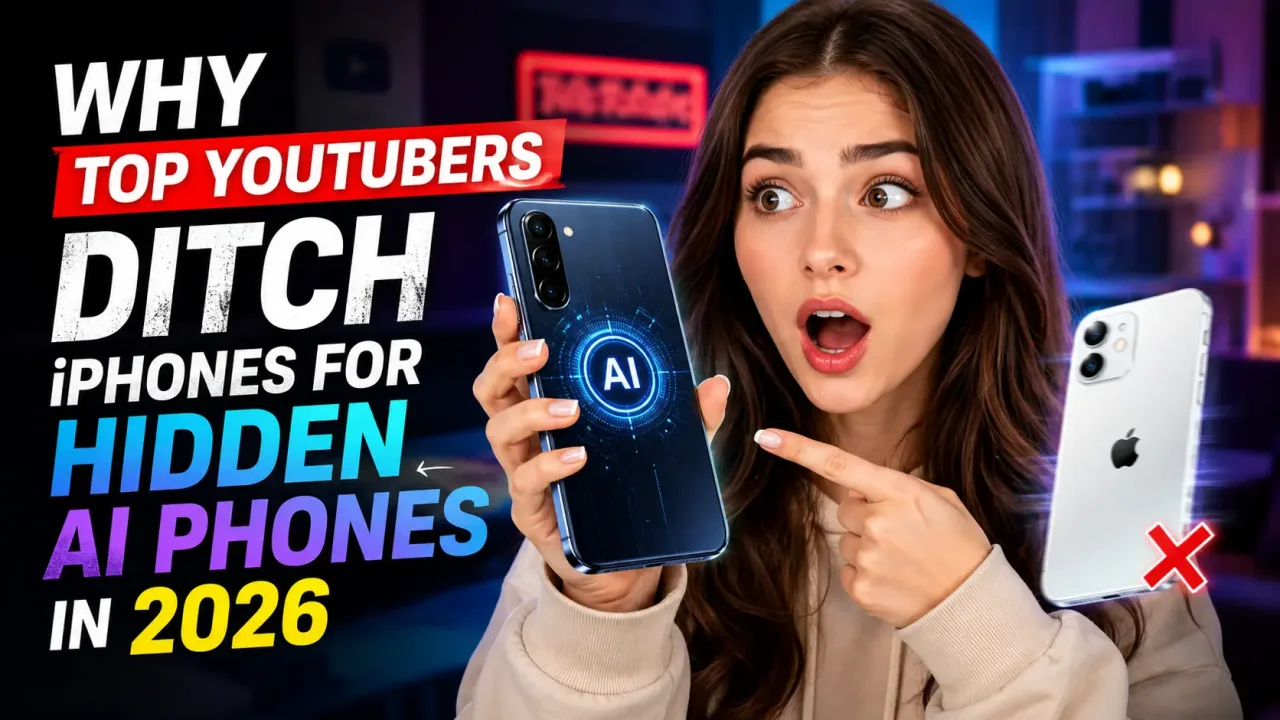
Scroll through enough tech YouTube in 2026 and you'll notice something odd. The same creators who used to unbox every new iPhone like it was Christmas morning are suddenly filming videos titled things like "I switched phones for a month and I'm not going back." No dramatic announcement, no brand deal disclaimer screaming from the description box — just a quiet, almost sheepish admission that the shiny new "AI phone" nobody's heard of is doing something their iPhone simply can't.
So what's actually going on here? Is this a genuine shift, or just the algorithm rewarding whoever posts the most contrarian take? A bit of both, honestly — but the "both" part is more interesting than you'd expect.
What this article covers
The iPhone Isn't Falling Behind on Hardware — It's Falling Behind on AI#
Let's get one thing straight: nobody's saying the iPhone is a bad phone. It's still one of the best-built, best-supported devices on the planet. The frustration creators keep bringing up isn't about the camera or the screen — it's about Siri, and more broadly, about how far behind Apple Intelligence still feels compared to what's happening elsewhere.
While Apple has taken a cautious, incremental approach to on-device AI, a wave of smaller manufacturers has gone all-in on building phones where AI isn't a bolted-on feature — it's the entire interface. Nothing, the London-based company founded by OnePlus co-founder Carl Pei, raised a $200 million funding round specifically to build what it calls "AI-native" devices, with a vision of software that adapts itself around the user instead of forcing the user to learn a fixed app grid. Even OpenAI has reportedly been working with chipmakers on a phone designed from the ground up around AI agents rather than traditional apps — the idea being that you talk to the device and it just handles things, instead of you tapping through five different apps to get something done.
For a content creator whose entire job depends on being first to try the interesting thing, that's an irresistible pitch. A phone that summarizes your entire inbox out loud while you're editing a thumbnail, or one that can generate a rough video caption without you opening a single app, isn't just a nice-to-have — it's genuinely useful for someone juggling ten tasks between uploads.
"Hidden" Isn't Some Conspiracy — It's Just Under-the-Radar#
The word "hidden" in conversations like this usually isn't as dramatic as it sounds. It just means these phones haven't been marketed with Apple-sized budgets, so most regular consumers have never heard of them. Niche AI-focused devices, experimental hardware from smaller Android manufacturers, and phones coming out of markets like China with aggressive on-device AI features have been quietly building a cult following among reviewers who actually seek this stuff out for a living.
Tech creators are, by nature, the exact audience that goes looking for these under-the-radar devices. It's part of the job description — finding the interesting thing before it becomes the obvious thing. So when a wave of AI-first phones started showing up at trade shows and import listings, it's not surprising that creators were among the first to actually put them through daily use and film the results.
Why This Resonates With Their Audience#
Here's the part that's easy to miss: creators aren't just chasing novelty for its own sake. A lot of their audience is genuinely tired of incremental phone updates. When every year's flagship looks nearly identical to the last one, with marginally better cameras and a new color option, "this phone thinks completely differently" is a much easier video to make interesting than "this phone has 12% better battery life."
There's also a very practical angle a lot of viewers relate to: content creators live inside their phones for research, quick edits, voice memos, and constant multitasking. A device that can genuinely reduce friction — even in small, unglamorous ways — earns real loyalty from someone whose entire day revolves around moving fast between tasks.
A Word of Caution Before You Rush Out and Buy One#
Before this turns into "throw away your iPhone tomorrow," it's worth being honest about the trade-offs, because creators covering these devices usually are too, once the excitement wears off. Many of these AI-native phones are still early-stage products. Software can be buggy. App ecosystems are nowhere near as mature as iOS or mainstream Android. Long-term software support is a genuine question mark for smaller manufacturers, and previous attempts at standalone AI hardware — the Humane AI Pin being the most infamous example — have shown just how easy it is to overpromise and underdeliver in this space.
Analysts have also pointed out a less exciting reality behind the AI phone boom: rising memory chip prices are making AI-capable phones more expensive to build, which means many of these devices carry premium price tags despite coming from unfamiliar brands — a tougher sell than it might seem from a glossy YouTube review.
So the honest takeaway from most of these videos isn't "ditch your iPhone forever." It's closer to "this is worth watching, and worth trying if you're curious," which is a very different message than the clickbait headline suggests.
The Bigger Picture#
What's really happening here isn't a mass exodus from Apple — it's a preview of where the whole industry is heading. Apple will almost certainly catch up on AI eventually; it has the resources and the userbase to do it on its own timeline. But for now, the most interesting experimentation is happening at smaller companies willing to take bigger risks, and tech creators — whose job is to notice those risks before anyone else does — are the ones surfacing it first.
If you're the kind of person who reads phone reviews for fun, keep an eye on this space in 2026. Not because your iPhone is about to become obsolete, but because the phones coming up behind it are quietly rewriting what a "smartphone" is even supposed to do — and the people testing them for a living are the first ones noticing it.

Read next

AI Laptops Revolutionize Video Editing in Just a Few Clicks
Remember the days when editing a five-minute YouTube video meant sitting hunched over your laptop till 2 AM, manually trimming clips, adjusting audio levels frame…

Best AI Smartphones Top Vloggers Are Using in 2026
Watch any successful vlog these days and you'll notice something: barely any of it was shot on a "proper" camera. The buttery-smooth walk-and-talk footage, the…

High Performance AI Laptops Under Rs 40,000 for Graphic Designing in 2026
If you've ever sat down to open Photoshop on a cheap laptop and watched the loading circle spin for what felt like an eternity, you already know the…

AI Laptops vs Gaming Laptops for Video Editing: Which Is Better?
You're staring at two browser tabs, both open for way too long. One is a sleek "AI laptop" with a marketing page full of words like "neural engine"…
0 comments